
pH stability screening
without the buffer series.
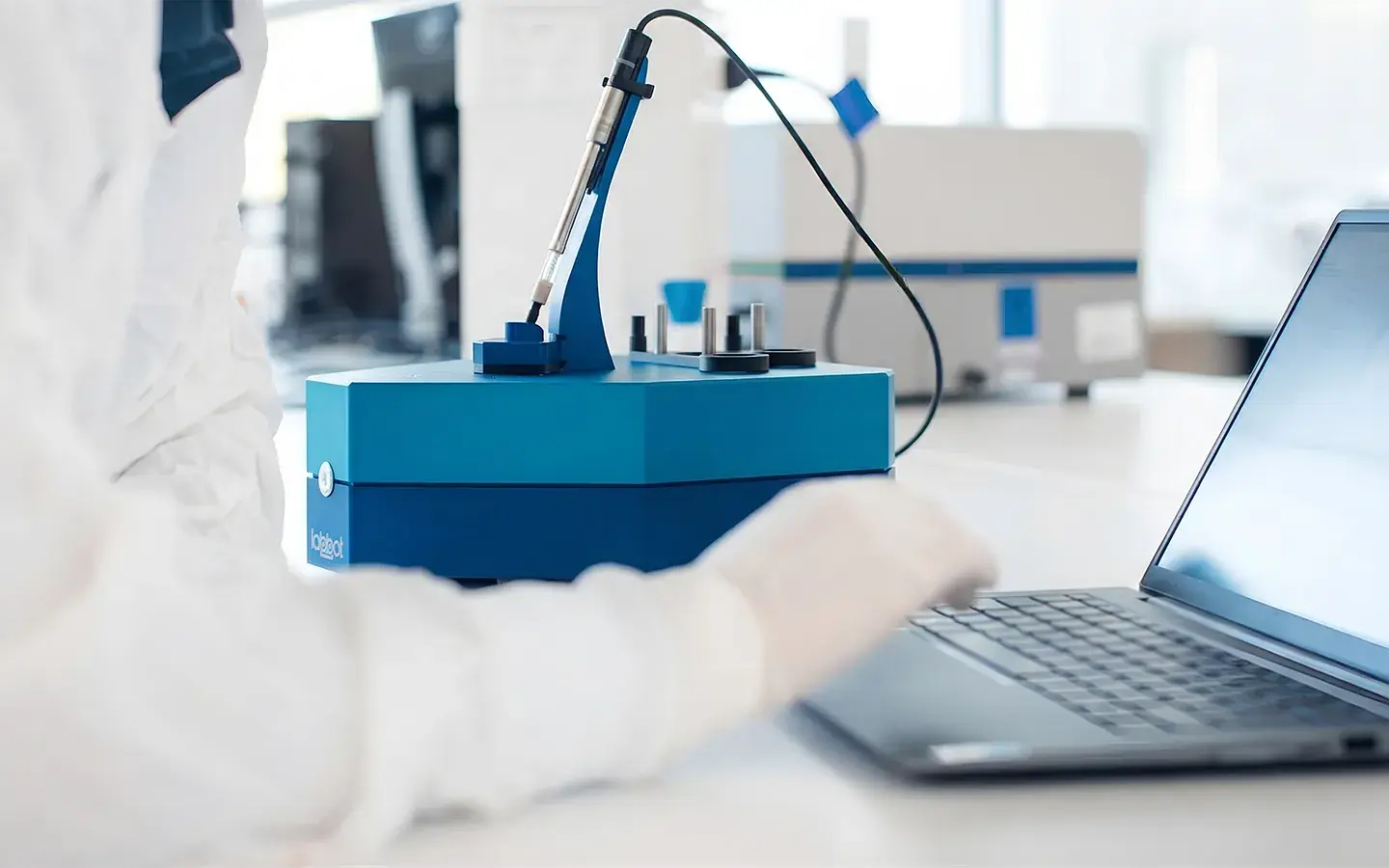
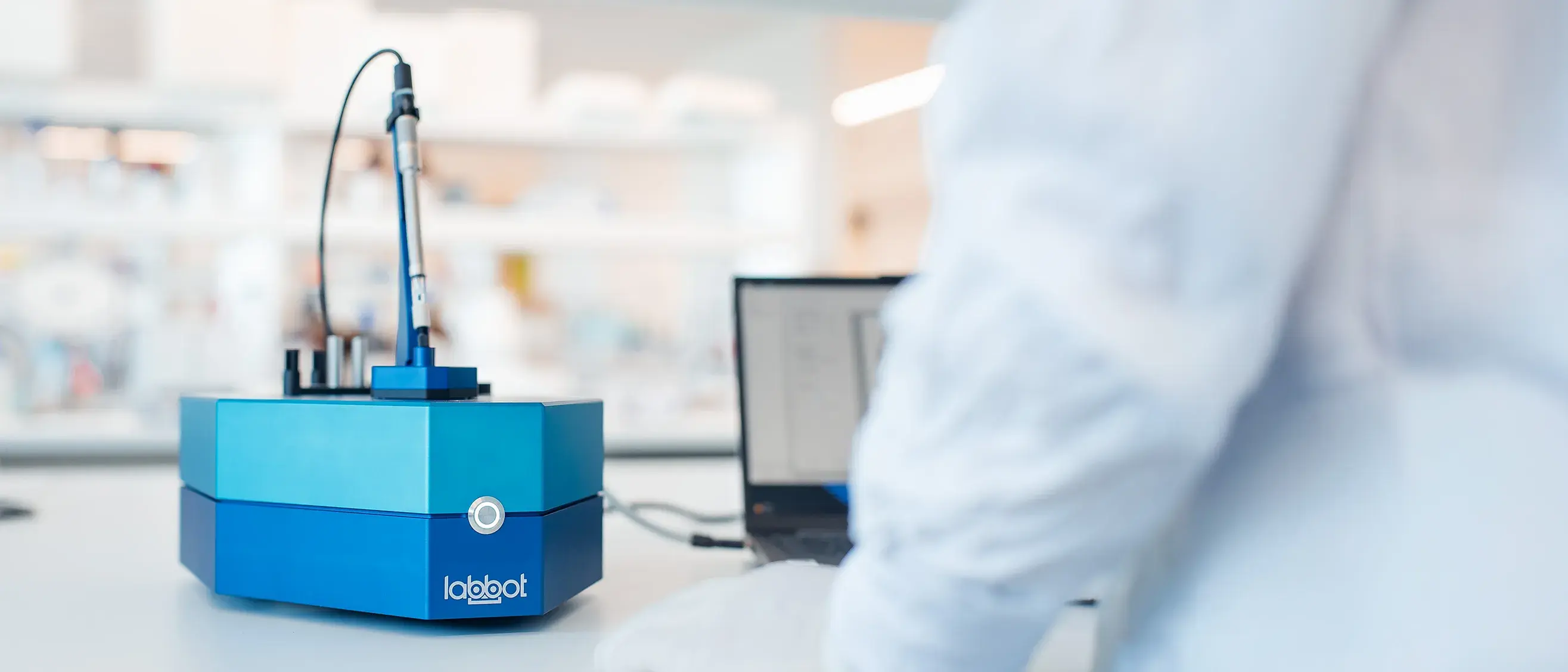
The Labbot instrument takes one sample across a pH range, unattended, and reads unfolding, aggregation and concentration at every step. See where your candidate is stable, where it isn’t, and what drives instability.
The pH stability window
is hard to estimate
pH affects unfolding and aggregation at every stage of development, and what a coarse screen misses tends to surface later. The value of a high-resolution screen is clear. Running one is the hard part.
- 01
Every point is
a sample prep. - 02
So screens are often limited
to a handful of points. - 03
Where it is stable, and what drives instability, remain open questions.
One sample prep to
map the pH stability window
With the stability window mapped, your candidates can be evaluated on solid data.
- 01
Every point,
from one sample prep.Load the sample, set the range, start the run: about five minutes of preparation. No buffers to prepare, nothing to start over.
- 02
So a handful of points becomes a curve.
Step down to 0.05 pH for near-continuous data. A finer step needs no extra protein and no extra hands-on work.
- 03
Where it is stable, and what
drives instability, get answered.Unfolding and aggregation are read together, so you see which starts first, and at what pH.
THE RUN
From sample to insights.
Try it on a virtual Labbot.
Easier to try than to explain. One sample goes into the cuvette, and the run does the rest. This one is sped up; the clock shows how long a real run takes, unattended.
The same approach, other questions.
Same sample, same four signals, a different variable. No dilution series, no buffer matrix, no new sample per point.
At what concentration does an additive start to matter, and when does more stop helping?
Add an additive to the sample in small steps, for example an excipient, a ligand, a peptide or a binding partner. Scattering and fluorescence show the onset of the effect and the point where it levels off, from one run instead of a series of preparations.
Used for: choosing a stabiliser and its dose, seeing whether and at what concentration a ligand binds, testing whether two peptides co-assemble.
How concentrated can it be before it self-associates?
Raise or lower the protein concentration in steps in the same cell and follow scattering. The run gives the concentration where the molecule starts to self-associate or phase separate, without preparing a new sample for each point.
Used for: high-concentration formulations, where self-association and phase separation cause opalescence.
How much does a formulation change shift the melt?
Ramp from 6 to 87 °C or hold at a set temperature. Intrinsic fluorescence (label-free) and scattering are read together, so unfolding and aggregation onset come out of the same run. The effect of an excipient or a ligand on thermal stability is read on the same instrument as the pH run.
Used for: ranking candidates and formulations by thermal stability, and seeing what a stabiliser adds.
Labbot changes conditions and measures at every step.
Labbot changes conditions around the sample, such as pH, excipients, concentration, temperature or shear, and measures light scattering, fluorescence, absorbance and pH at every step.
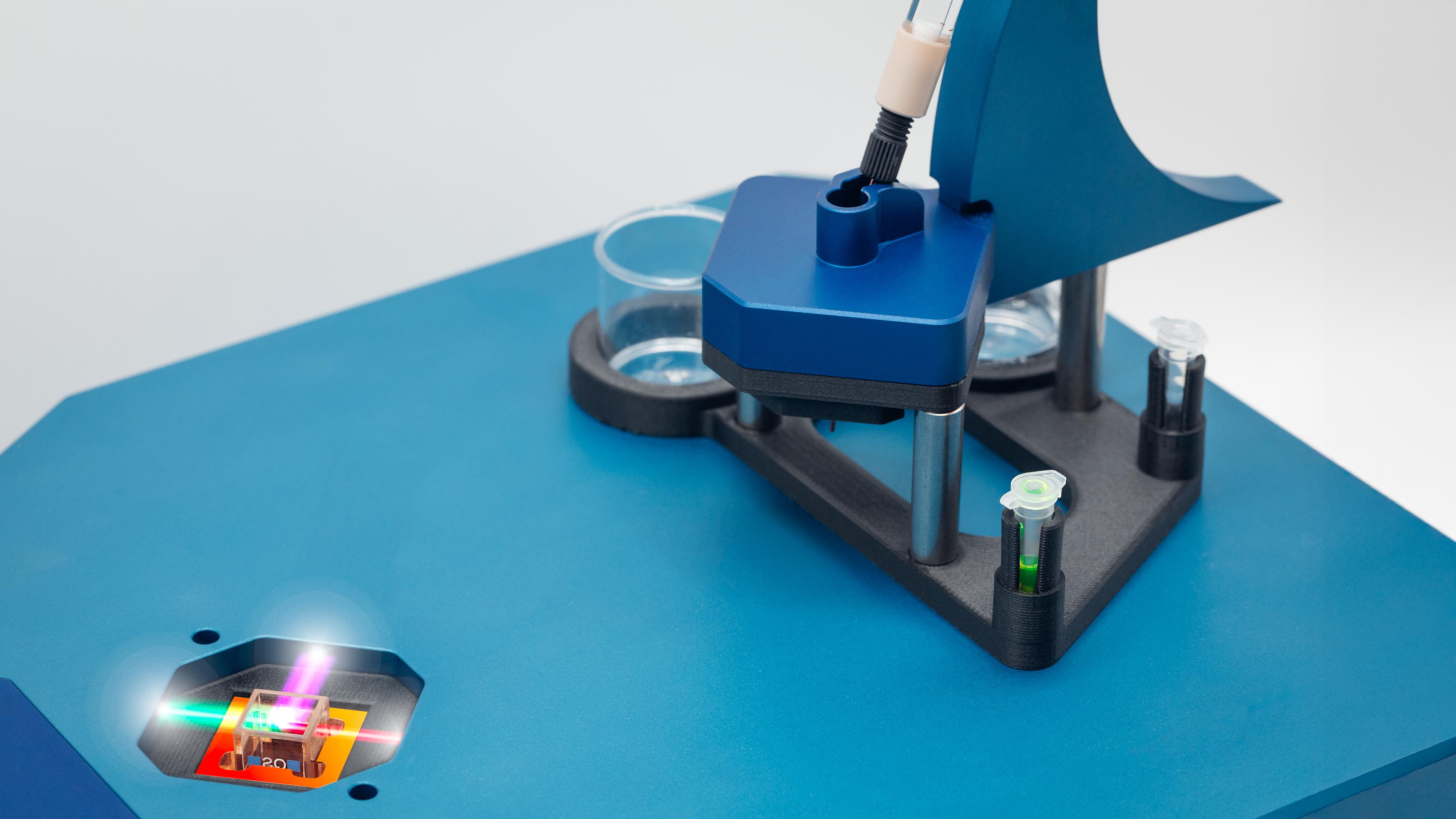
A small sample goes into a standard optical cuvette, and the conditions are programmed up front.
The instrument drives the sample through the conditions of interest, with no manual handling.
Every channel is recorded together, in real time, from that same sample. All in one dataset.
Your material. Your question.
Our eyes on the data.
Fourteen years of measuring how proteins behave under changing conditions comes with the instrument. Experiment design, the first runs together, the data read with you.
Every molecule behaves differently, and the first run on a new one is rarely the one that answers the question. We expect to be there for it.
A demo on your sample, free.
One sample of yours, run on the platform, the data reviewed together.
You'll talk to one of the people who built the instrument.
Fewer candidates lost to something that was knowable earlier
Built by biophysicists, for formulation and process teams.
Labbot is led and built by biophysicists. The people who designed the instrument hold PhDs in the field and have spent their careers measuring how proteins behave under changing conditions.
The later a stability problem surfaces, the fewer options are left and the more each one costs. Everything we build is aimed at moving that moment earlier.
Let's talk
Tell us about your molecule and the pH question behind it. You'll talk to one of the people who built the instrument.
Placeholder copy · expect the words to change